Showing posts with label Television. Show all posts

Sunday, August 21, 2022

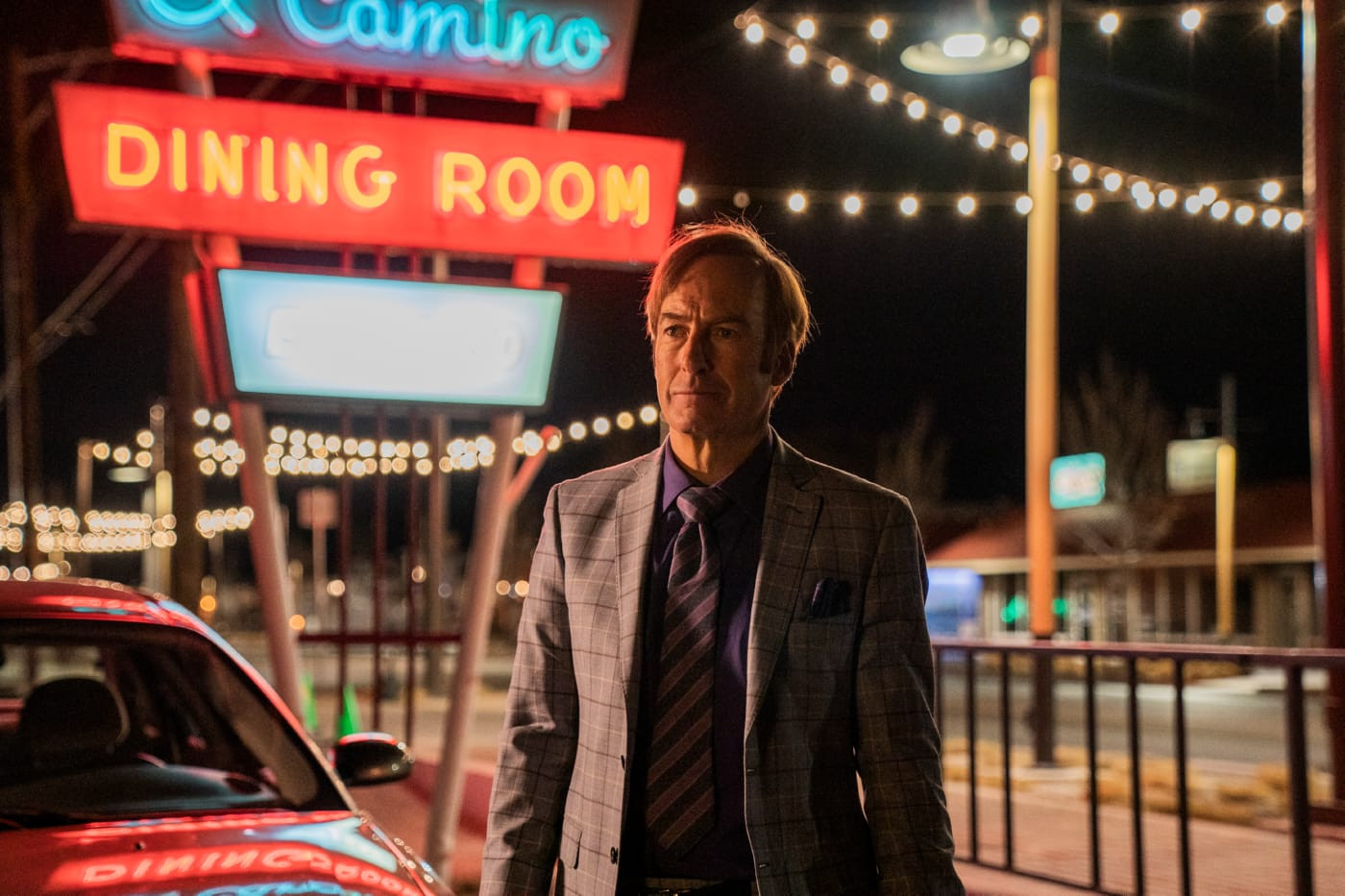
Better Call Saul: "Saul Gone"


“What would you do if you had a time machine”?

That’s the question Jimmy/Saul asks Mike and Walt in the flashbacks that occur throughout "Saul Gone". For both characters asked, the answer is true to their characters. Mike would go back to the day he took his first bribe that indirectly led to his son Matt’s death. Walt would go back to the day he decided to leave Grey Matter and lost out on billions of dollars, rather than the day he decided to become a criminal which ultimately led to his family being destroyed.

For Jimmy, he’d go back to when Warren Buffet first became famous and invest money in becoming a billionaire. In Saul’s conversation with Walt, he’d go back to the day he broke his leg performing a Slippin’ Jimmy scam. Neither Mike nor Walt is impressed with these answers, with Mike prodding Jimmy to think of any regrets he may have had and Walt dismissing Saul as having “always been like this”.

The third and final flashback with Chuck doesn’t have Jimmy asking him this question, but it’s clear that it’s the answer to what Jimmy would do if he did indeed have a time machine. It’s back when Jimmy first started out as a lawyer and bringing Chuck supplies. Chuck invites Jimmy to stay, only for Jimmy to dismiss him, not believing that Chuck would be interested in hearing about his day\. It’s a moment of genuine connection from Chuck that may or may not have ultimately salvaged their relationship if Jimmy had taken him upon his invite.

The finale itself functions as somewhat of a time machine, going from Gene Takovic to Saul Goodman and then ultimately back to Jimmy McGill. After getting captured by the police, Gene calls up the Cinnabon to let them know they’ll need a new manager and then has a breakdown in his holding cell. The scene is similar to Walt’s breakdown in the crawl space in Breaking Bad, where it is believed by many that Walter White died, and Heisenberg was born. Similar to that scene, Gene Takovic dies, and Saul Goodman is reborn.

Saul manages to convince the prosecutors to reduce his life sentence to seven and a half years at a golf-course prison, lying that his reasons for aiding Walt were in fear for his own life after he kidnapped him and held him at gunpoint in the desert. Both the prosecutors and Marie(!) know this is bullshit but Saul has them by the vice and they're forced to acquiesce. It isn't until Saul smugly makes a request for ice cream in exchange for information on Howard Hamlin's death does he find out that Kim already confessed and is facing a civil suit.

This leads to Saul's final transformation back into Jimmy McGill. With Kim in attendance at his hearing, Jimmy confesses that while he was indeed afraid of Walt, he made the choice to help him out of his own volition and reaped the rewards for his crimes. He also finally comes to terms with his role in Chuck's suicide, admitting that he got his malpractice insurance canceled. 

Jimmy's confession may have saved his soul, but it doesn't save him from eighty-six years in the federal prison he described as "the Alcatraz of the Rockies". Yet on the bus ride there, several inmates recognize him as the infamous lawyer and chant "Better Call Saul!". It's the one moment in the finale that comes close to being cartoonish, yet instead it feels earned, affirming Jimmy's legacy while also assuring the viewer that his time at ADX Montrose won't be the total "hell-hole" he described it as.

In the final scene, Kim visits Jimmy in prison, claiming to be his attorney. They both share a cigarette (in a brilliant callback to their first scene in the pilot) and reflect on Jimmy's decision. As Kim leaves, she steals one last glance at Jimmy, who gives her the pointed guns gesture he gave her back in Season 4. Whether this is the last time they ever see each other, or simply the last time we the audience will ever see them together, it's a perfect coda on which to end their relationship and the series.

I'd like to thank everyone who took the time to read my Better Call Saul reviews. It's been a joy watching and reviewing this excellent show, which has proven to be equivalent to Breaking Bad in terms of quality and legacy, if not more so in certain areas. What a marvelous experience this show turned out to be.


Notes and observations:

* Bill Oakley once again becomes the butt of the joke, as Saul hires him on as his lawyer, only to hijack the hearing and completely torpedo his plea deal.

* Kim goes back to her lawyer roots, volunteering at Florida's Legal Aid and sorting files. It's a far cry from where she was years ago, but it's a somewhat hopeful note to end her character on.

* Aside from Marie, Breaking Bad cameos included SAC Ramey as well as the appearance of Gomez's wife Blanca, who was mentioned but never seen on the parent show.

*Walt's final scene in the flashback goes a long way to establish him as the rotten prick he's always been, for those who felt like "Felina" was a little too kind to his character.

* An excellent script and directing from co-creator Peter Gould, who ultimately deserves the lion's share of credit for this show rather than Vince Gilligan (who stepped away after Season 3).

Tuesday, August 9, 2022

Better Call Saul: "Waterworks"


With there being two episodes left, it's only natural that we check back on Kim, who is just as central to the show as Jimmy is. "Waterworks" is an incredible penultimate episode of Better Call Saul, providing closure to Kim and Jimmy's relationship while also leaving room for it in the series finale, which promises to be nothing short of apocalyptic.

Having dyed her hair brown and now living in Florida, Kim lives the life of an ordinary housewife, making potato salad (sans mayonnaise) and doing jigsaw puzzles. At her job, she continues to live in mundaneness and self-flagellate herself for her sins, even refusing to choose the flavor of her co-worker's birthday cake. We get to see the other side of her phone call with Jimmy, where she advises Jimmy to turn himself in. Jimmy, somewhat righteously, furiously points out that she has yet to do so herself for her role in Howard's murder. Kim ends the phone call with an "I'm glad you're alive", seemingly closing the book on their relationship for good.

True to Kim, she takes Jimmy's accusations to heart and travels to Albuquerque, where she gives Howard's wife and the district attorney an affidavit confessing her involvement in Howard's death. As Cheryl points out however, Howard's reputation and legacy is still destroyed, and Kim is unlikely to be prosecuted as there is no proof or knowledge of where his body is. On the way back to Florida, Kim finally allows herself to feel the full weight of her guilt and breaks down sobbing on the bus (just give Rhea Seehorn next year's Emmy). Similar to when she was caught stealing as a child, the universe won't punish her for her sins.

Meanwhile, in Omaha, Gene follows through in breaking into the cancer patient's house, proceeding to compound his crime by stealing the man's watches and preparing to knock out the now-awake man with an urn full of his dog's ashes. A police car shows up and startles Jeff, frightening him enough to crash his car in an escape attempt. Gene uses the distraction to flee the scene and later receives a call from Jeff, who has been accused of robbing the mark's house.

We get a flashback to Alburquerque, where Kim arrives at Jimmy's office to sign the divorce papers. Jimmy is cruelly flippant about the whole thing, clearly using his Saul persona as a coping mechanism to deal with the end of their relationship. Kim leaves the office and encounters Jesse Pinkman, who is there with his partner Emilio to get legal counsel for the latter. After recognizing Kim from when she helped out his friend Combo, Jesse asks her if Saul is a good choice for legal representation. "When I knew him, he was", Kim finally replies before running back to her car in the rain, not knowing that she has indirectly helped bring her ex-husband into Walt and Jesse's orbit

Gene calls Marion and promises to bail her son out. Growing suspicious of why Jeff would call Gene instead of her, as well as his knowledge of the law in Omaha, Marion uses her new laptop to look up his old Saul Goodman commercials, thus confirming his identity. Gene arrives and attempts to stop her from calling the police, ripping the cord out of the wall and fashioning it as a garret. "I trusted you", Marion almost tearfully replies, distracting Gene enough for her to use her Life Alert to report him to the police. His cover now blown, Gene immediately flees the house.

Where do we go from here? The series finale of Breaking Bad at least ended on a decisive victory for Walter White. I don't see one for Jimmy McGill at this point.


Notes and observations:

* It's only natural that the man who started this all, Vince Gilligan, writes and directs this episode (ironically this is his first and only solo writing credit on the show). Lots of great camerawork but my favorite shot, other than the final scene with Kim, has to be the reflection of the colorful Saul commercial in Gene's glasses.

* I haven't commented on the teasers for the final six episodes as they have been deliberately vague, but the one for next week's series finale deserves special mention. The camera pans on an abandoned car and the monochrome slowly transitions to color as Gene attempts to remember the phrase for the vacuum cleaner repair man (played by the late Robert Forster). Does this mean that the finale will be in color?

* I really want to try tuna salad with Miracle Whip.

* I will unfortunately be out of town when the finale airs so the review for it will sadly be delayed.

Wednesday, August 3, 2022

Better Call Saul: "Breaking Bad"

It's only fitting that the long-awaited Walt and Jesse appearances happen in an episode titled "Breaking Bad". Not only is it a reference to the parent show, but it also brings Saul's first appearance from the Breaking Bad episode "Better Call Saul" full circle. But the episode's title isn't just a nod towards the show that started it all. It represents the final turning point for Jimmy McGill, who proves he still has some way to fall even after all that has happened to him.

Fresh off of the department store heist, Gene calls Francesca for information on what has happened since leaving Albuquerque. Upon learning that Kim called Francesca and is currently working in Florida, Gene calls her place and asks to speak to her. What follows is a wordless sequence that ends with Gene destroying the phone booth and falling back on old habits, recruiting Jeff and his friend Buddy for a new scheme that involves drugging rich men and stealing their identities. It's here that a fourth persona of Jimmy McGill emerges named "Viktor", the same name he came up with when and Kim were running scams. When their latest mark turns out to have cancer, Buddy refuses to go through with the crime, leading to Gene to break into the man's house to finish the job.

We get an extended look at the scene where Walt and Jesse took Saul out into the desert, with him connecting the dots and realizing that Walt is Heisenberg after taking a look inside the RV. Jesse asks about Lalo and it's clear how the man still haunts Jimmy years after their last confrontation. Later, Mike brings information on Walt to Saul, including the fact that he has lung cancer, and cautions against getting involved with him. The final scene intercuts Saul walking into the high school where Walt worked at to Gene breaking into the mark's house. Similar to how getting involved with Walter White ruined Saul Goodman, Viktor's determination to pull off schemes is destined to ruin Gene Takovic.


Notes and observations:

* There's a nice reference to the Breaking Bad episode "Four Days Out" when the RV overheats, forcing the trio to wait for the engine to cool down.

* Aaron Paul and Bryan Cranston look noticeably older than they were back in Breaking Bad Season 2, but it's still electrifying to watch the duo slip back into the characters.

* Through Francesca, we get some closure on Skylar (who got a plea deal with the DEA after all) and Huell (who went home to New Orleans after leaving the safehouse). We also find out that Bill Oakley, the slovenly lawyer who butted heads with Jimmy, is now a defense attorney.

* An interview with Thomas Schnauz confirms that the Breaking Bad scenes weren't shot on film like the one back in Season 4's "Quite a Ride", but were shot digitally with grain added to them.

* Gene's first mark Alfred is played by none other than Devin Ratray from Home Alone.

* Marion's joy at discovering funny cat videos on the Internet is infectious.


Wednesday, July 27, 2022

Better Call Saul: "Nippy"


The final season of Better Call Saul has been a delightful subversion of expectations. Nacho, Howard and Lalo were all killed in the span of eight episodes and Kim ended up leaving Jimmy just the episode prior. With "Fun and Games" seemingly leaving the Jimmy timeline for good and picking up the Breaking Bad timeline, it was easy to assume that this episode would finally give us our long-awaited Walt and Jesse appearances. Instead, "Nippy" brings us back to the Gene timeline for a fantastic episode that once again subverts expectations.

Where the Gene timeline previously left off, Gene was harassed by a cab driver named Jeff who knew who he was. This led to Gene nearly relocating himself before he decided he'd deal with the problem himself. He quickly turns the tables on Jeff by befriending his elderly mother Marion (played by a delightful Carol Burnett) and offering to teach Jeff "the game" in exchange for his silence.

What follows is a relatively low-stakes (in the overall tapestry of the show) but no less exciting heist sequence, with Gene going through steps including casing the department store, timing how long it takes for the slovenly security guard to consume a cinnamon bun away from the security cameras and creating an obstacle course for Jeff to practice his sweeping of the place. It's the first time we've seen Gene truly alive and reminiscent of the Jimmy McGill we know and love from the previous episodes.

The plan hits a last-minute snag when Jeff slips on the store's floor and knocks himself out, forcing Gene to improvise with a teary-eyed story about how alone he is to the security guard. The scene is very similar to Walt's phone call to Skylar in "Ozymandias", as we are unaware of which parts of the performance is a fabrication and which parts are genuine. In particular, Gene mentions his brother's passing and having no wife, both of which we know are true and seems like Jimmy is grieving for the first time in his life.

The heist is ultimately a success, with Gene blackmailing Jeff into staying away from him by threatening to turn him into the police for the theft. Upon returning to the scene of the crime, he comes across a suit and tie that look like something he would wear back in his Saul days. Gene stares wistfully at the reminder of his former life before leaving it on the rack. He might have gotten a rush reliving his glory days, but those days are over.


Notes and observations:

* Despite being one of Breaking Bad's most prolific directors, Michelle Maclaren has only directed two episodes of Better Call Saul prior to this one. She adds series-best work to what was already an impressive resume of episodes, particularly the montage of Gene delivering cinnamon buns to Jim O'Heir's security guard to the tune of Mission Impossible's "Jim on the Move".

* Much has been made over the recasting of Jeff, due to Don Harvey's scheduling conflicts with Season 6. For what it's worth, Pat Healy gives a stellar performance.

* The intro for the episode, which has steadily been turning black and white throughout the course of the seasons, goes completely blue.

* We didn't get the Walt and Jesse sighting we thought we would, but Gene brings up Walt obliquely while coaching Jeff on running through the store.

* A lot of great details throughout this episode, from Gene putting on Marco's ring, to the reappearance of the security guard that busted the shoplifter from Season 3.

* The previews for the final episodes have been interesting, showing shots of desolated places (Saul's office, the desert, etc.) while 

Tuesday, July 19, 2022

Better Call Saul: "Fun and Games"


These reviews assume you watched all of Breaking Bad. If you don’t want to risk spoilers, don’t read this article.

It's impossible to discuss Breaking Bad's legacy without mentioning "Ozymandias". The antepenultimate episode of Breaking Bad is widely considered to be the show's best and most devastating episode for its punishing series of events, bringing home the consequences of Walt's actions and the worst possible outcome for each character. When the final season of Better Call Saul began, I wondered whether or not the show would be able to produce an episode of that devastating quality and emotion.

Suffice it to say, "Fun and Games" is that episode.

Unlike "Ozymandias", "Fun and Games" moves at a leisurely pace, which is typical of the show it is rooted in. The first half of the episode is concerned with the Mike/Gus plot. Gus ultimately wins his war with the Salamancas, earning Eladio's favor and control of the northern drug productions, while Mike contacts Nacho's father Manuel to give him closure on his son's death. These scenes are superbly written and acted by Giancarlo Esposito* and Jonathan Banks, closing off their story arcs in ways that are fitting for where both characters end up in Breaking Bad. The scene with Manuel is particularly devastating, driving home how deeply pointless and corrupting Mike's dealings with the cartel have made him.

*The scene with Gus and the bartender may very well be the best Gus scene since Breaking Bad, notably for its interiority and subtext. The show has often struggled with saying anything new about Gus that viewers didn't already know from the parent show, yet this scene perfectly highlights his latent humanity as well as his feelings towards his late partner Max.

Elsewhere, Jimmy and Kim try to move on from the events of the last episode. Per Mike's instructions, they go about their day as if nothing happened, yet it's clear they're still struggling with their feelings of guilt over Howard's murder. When they go to Howard's memorial, they learn that HHM is downsizing and they encounter his widow Cheryl, who refuses to believe that Howard was a drug addict and presses Jimmy on his role in Howard's death. This leads to Kim concocting a story on how she witnessed Howard snorting cocaine back when she worked at HHM. It's yet another moral line that the character crosses and the worst part is that she knows it.

This all leads to one of Better Call Saul's most devastating scenes. Fresh off of quitting the bar, Kim is confronted by Jimmy, who also discovers that she is leaving him. It's the equivalent of the Walt and Skylar knife fight in "Ozymandias", yet here the knife is metaphorical rather than literal. Kim tells Jimmy that they're bad for each other and reveals that she withheld the truth about Lalo's survival from him, admitting that she was afraid they'd break up and dissolve the scam because she was "having too much fun". Jimmy can do nothing as Kim resumes packing.

This leads to a time skip, as we finally catch up with the Breaking Bad timeline. Saul wakes up next to a prostitute and starts his day in typical Saul Goodman fashion. He speaks through his Bluetooth while taking a shower and driving to work while listening to his commercial over the radio. Yet, there's now a sense of tragedy and loss as he enters his office and contacts a new client. It's the moment we've waited six seasons for, the birth of Saul Goodman, and now that it's here, it's nothing short of devastating.


Notes and observations:

* It's ironic that the week after Rhea Seehorn finally(!) gets her well-deserved Emmy nomination that she seemingly exits the show with one of her best performances. 

* It's redundant at this point to praise the show's openings, but this week's cold open, set to Harry Nilsson's "Perfect Day", was truly a masterwork of filmmaking and editing, emphasizing the now broken barrier between the legal side and the cartel side.

* I assume that next week's episode will introduce the long-awaited Walt and Jesse appearances now that we are fully caught up with the Breaking Bad timeline. It's entirely possible however we may get flashbacks to the Better Call Saul timeline as we see Jimmy pick up the pieces following Kim's departure.

* Presuming this is the last time we see Hector Salamanca, Mark Margolis delivers one hell of a farewell, from his smugness to his righteous indignation to Don Eladio dismissing his claims of Gus's attempting to assassinate Lalo.

Tuesday, July 12, 2022

Better Call Saul: "Point and Shoot"


Part of what made the fifth season of Better Call Saul the show's best season was how it tied together the two major but separate storylines of the show in a way that paid off in spades. After "Plan and Execution's" shocking cliffhanger, I largely assumed that the final six episodes would once again be mainly focused on the intertwining of both the legal world and the cartel world. However, Vince Gilligan and Gordon Smith (the team behind last season's "Bagman") subvert expectations with an episode that gives viewers what they were waiting for while also cleaning the slate for the show's home stretch.

After a typically beautiful teaser that hints at things to come, the episode picks up right where it left off with Lalo menacing Jimmy and Kim after killing Howard. Lalo's plan, as it turns out, is to send Jimmy to Gus's house to shoot him. Jimmy convinces Lalo to instead send Kim in order to get her out of the apartment and leave him at the mercy of Lalo. Kim is ultimately thwarted by Mike, who goes to Jimmy's apartment to kill Lalo once and for all, not knowing that Lalo was using Kim as a distraction to sneak into the laundromat and get his proof once and for all. Upon realizing this, Gus heads to the laundromat where he is intercepted by Lalo.

The way the episode unfurls plot is extremely reminiscent of Breaking Bad, with the caveat that we know that half of the main cast are safe from harm. As a result, the tension is derived not from if Gus will survive but how. Watching how Gordon Smith's script gets from point A to point B is electrifying to watch and it makes the moment where Gus gains the upper hand and kills Lalo feel gratifying and earned. The revelation that Lalo and Howard are both buried underneath the superlab where Walt and Jesse will cook is a morbid way to end the episode and it adds an extra layer of pathos and horror to Breaking Bad.

"Point and Shoot" is a fantastic episode of television, expertly carrying over the tension from the previous episode while also subverting expectations and clearing the chessboard so the rest of the season can go anywhere. Presumably, the final five episodes will focus on Jimmy and Kim and how they deal with the whirlwind of events that led to Lalo at their doorstep and Howard's death. Whatever happens going forward, I have faith that Better Call Saul will deliver it in a way that leaves us emotionally devastated yet satisfied.


Notes and observations:

* From what I gather, this was the episode Bob Odenkirk was filming when he had his heart attack.

* I'd like to give one final shout out to Tony Dalton, who turned what could've easily been an afterthought character into one of the show's most iconic. His final laugh as he bleeds out perfectly encapsulates the force of chaos Lalo was. 

* Jonathan Banks has turned in beautifully understated work as Mike, but this episode is where he gets to show his range, from the professional hitman who expresses contempt for what Jimmy and Kim did to the somber way he treats Howard's corpse as respectfully as he can given the circumstances.

* Giancarlo Esposito also gets to show his range as Gus, from the tense demeanor once he realizes Lalo is on to him, to the hate-filled rant he gives to Eladio and Lalo to the calm professional who lets Lyle know he won't be coming into work while recovering from a gunshot wound. At times, Gus felt superfluous to the narrative, but this episode brings it all home, showing his transformation into the cold, calculating kingpin in Breaking Bad.

* The moment where Kim considers flagging a police car on her way to kill Gus is another fantastic showcase in silent acting from Rhea Seehorn.

* The structure of this season has definitely been unusual, with the first three episodes feeling like an extended conclusion to Season 5 and the fourth feeling more like the season's true beginning. With the Lalo/Gus/Mike storyline basically done with, there'll probably be a time jump similar to Season 4's "Something Stupid" as we catch up to Saul's first appearance on Breaking Bad and the post-Gene timeline.

* Excellent direction from Vince Gilligan on all accounts, particularly the final showdown in the lab where we get to see from Lalo's video camera (a reminder that this show is set in the mid-2000s) as well as the almost angelic shot of Gus standing over a dying Lalo.

* Dave Porter has always been one of the most underrated composers in television with his score for both Breaking Bad and Better Call Saul, but his work in this episode is truly some of his best, underlining the chaotic feel of this episode.

* I apologize to those who missed my Barry reviews. I came down with COVID around the time of the second half and I had just started my summer classes, so I decided to postpone the reviews.
----------------------------------------------------------------

Let me know your predictions for the final five episodes in the comments below!


Tuesday, May 24, 2022

Better Call Saul: "Plan and Execution"


These reviews assume you watched all of Breaking Bad. If you don’t want to risk spoilers, don’t read this article

"Plan and Execution" serves as the climax to this half-season and boy, what a climax it is. Jimmy and Kim's full plan to discredit Howard is revealed and it goes off without a hitch, despite a last-minute setback. As it turns out, the private investigator Howard hired to track Jimmy is secretly working for them and delivers a new batch of doctored photos to Howard laced with the drug they procured last week. By the end of it, Howard's credibility is damaged if not outright destroyed and the Sandpiper case is settled. The way the episode unfurls this is vintage Better Call Saul. once again allowing the viewer to piece together exactly what is going on rather than spoon-feeding information to them. 

Meanwhile, Lalo returns to Albuquerque and sets up a hiding spot in a sewer grate across the street from where Gus' superlab is located and makes a video documenting his proof to Eladio. Upon realizing his phone call to Hector is bugged however, he concocts a story that he'll raid the lab that night and kill Gus before leaving the sewers. Gus and Mike hear the fake story and make plans to ensure that Mike's men will cover Gus and put Lalo down once and for all.

Jimmy and Kim celebrate their victory when a visibly disheveled Howard shows up and excoriates them for ruining his life. He compares them to Leopold and Loeb and correctly calls Kim out on how her part in this wasn't at all necessary; she did it because she liked it. As Jimmy and Kim tell him to leave, Lalo shows up and insists on talking with them, but not before putting a bullet in Howard's skull.

I mentioned last week that Kim's choice in forgoing her luncheon with the legal group in favor of rescuing the scam was a point of no return for the character. I assumed that this choice would result in her disbarment and while that may still definitely be the case, the immediate consequences here are much more fatal and dire. Regardless of what happens to Kim in the final six episodes (as we already know that Jimmy will survive this), an innocent man is dead because of her and Jimmy's machinations and there really is no going back. I truly have no idea how the show will be able to wrap this storyline up and catch up to the Breaking Bad timeline in just six episodes, but considering how well-crafted this season and really the entire show has been, we're in good hands.


Notes and observations:

* I already mentioned Patrick Fabian's performance a couple of weeks prior, but he truly shows his range in this episode, from the genial way he treats the HHM employee, to his mounting panic during the deposition and his final monologue towards Jimmy and Kim, where he brokenly reveals the state of his marriage to them.

* Early on in the episode, Howard shows a nervous HHM employee how to temper a shaken can of ginger ale by applying centrifugal force to it. He reveals that he got the tip from Chuck and stares wistfully at a portrait of his former partner and friend. The moment serves as a nice reminder of the man whose relationship with Jimmy formed much of the backbone of the show's first few seasons as well as a thesis statement on the slow boil that Better Call Saul has been over the past six seasons

* As sympathetic as Howard has become. I love how the episode also shows he still has a bit of an asshole side, such as his persuasion of Irene to use a wheelchair in the meeting and his determination to fight the settlement despite how many years it would take to the detriment of the clients.

* Thomas Schnauz, who previously wrote and directed last season's phenomenal "Bad Choice Road", also helms this episode and delivers a masterclass in filmmaking, from the wordless opening scene of Lalo returning to Albuquerque to the staging of the final scene in the apartment. Truly, Better Call Saul is weekly film school in television format.

* Speaking of film school, the trio of students that Jimmy once again hires for a bit of last-minute editing are truly some of my favorite side characters on either show. In what will most likely be their final appearance, we get some more insight into each one: the leader being a smug know-it-all, the girl being relentlessly perky and the generic middleman apparently being a jogger in his spare time.

* Let me know your predictions for the final six episodes in the comments below! 

Tuesday, May 17, 2022

Better Call Saul: "Axe and Grind"


These reviews assume you watched all of Breaking Bad. If you don’t want to risk spoilers, don’t read this article

Last season's sixth episode opened with a flashback with a young Kim and her mother that was juxtaposed with Kim's decision to marry Jimmy, so it's only natural that this episode also juxtaposes Kim's childhood with another major decision she makes. Young Kim is caught shoplifting a pair of earrings and necklace and is scolded by her mother. Upon exiting the store however, Kim's mom is impressed with Kim's crime and reveals that she stole back the items for her. The scene speaks volumes for how warped Kim's childhood was and helps explain her struggles with following the law and her love for Jimmy.

"Axe and Grind" has Kim and Jimmy preparing for "D-Day", the final step of their plan to get Cliff to settle the Sandpiper case and damage Howard's reputation. Once again, the show chooses not to let us in on what the final steps of their plan are, offering us breadcrumbs such as a visit to Dr. Caldera to get a drug that makes the user appear to be high, and Jimmy reuniting with his film crew to film what is presumably an incriminating video. Meanwhile, Cliff, impressed with Kim's pro bono work, offers her a meeting with a legal group that promotes pro-bono work and is looking to expand in New Mexico. Kim's only reservation is that the meeting will take place on "D-Day", though Jimmy assures her that she won't have to be there to pull off the final steps.

On "D-Day" however, Jimmy runs into the real judge they're using as part as of their plan and realizes that they didn't know about one major detail; his arm is in a sling. This is enough for Jimmy to postpone the con and he calls Kim, who is on her way to the meeting, to let her know. After a brief look of indecision, Kim states, "It happens today" and makes a U-turn back to Albuquerque. Whatever happens next week, Kim's made her decision and there's no going back.


Notes and observations:

* Lalo continues his adventures in Germany where he tracks down Casper, one of the men who worked with Ziegler on the superlab and after a lengthy chase, cuts off his leg with an axe and prepares to interrogate him. While the Howard storyline looks like it'll reach it's conclusion next week, I genuinely hope that Lalo's will continue into the back half, if only because Tony Dalton's been criminally underused this first half.

* This is the second episode this season to be directed by a cast member, this time Giancarlo Esposito, who was chosen ironically for a episode where Gus doesn't appear at all. He pulls off some truly excellent shots, such as the scene where Howard prepares a latte for his wife and the hard cut from Jimmy and Kim kissing to Casper chopping wood with an axe.

* Speaking of Howard, the scene following the cold open opens on him getting ready for his day and sharing a conversation with his estranged wife, who unceremoniously dumps the coffee he prepared for her into a thermos. This scene works wonders to make Howard a sympathetic character and has me genuinely worried for him going into the midseason finale.

* I love how subtly this episode (and really the entire season) implies that Kim's reason for continuing the con isn't so much out of concern for the Sandpiper residents and more so out of revenge for the man who treated her poorly at HHM. The look on Rhea Seehorn's face as Kim forces herself to lie about her true feelings regarding Howard to Cliff is a fantastic bit of acting.

* The scene where Mike watches his granddaughter from across the street in his safehouse as he instructs her in stargazing is one of Jonathan Bank's best performances in either show.

* Dr. Caldera shows Jimmy and Kim his black book of clients, which eagle-eyed viewers will remember was in Saul's house in the flashforward in the Season 6 premiere. Kim also happens upon a card for the vacuum cleaner repairman, who was played by the late Robert Forster. Whether this is a hint at her ultimate fate or a misdirect remains to be seen.

* We see the beginnings of the Francesca we know from Breaking Bad, with Jimmy forcing her to make a phone call to HHM and her sarcastic reponse to him ordering her to clean up the toliet after an unruly customer urinates in it.

Monday, May 16, 2022

Barry: "all the sauces"


The show that Barry reminds me of most is Breaking Bad, not just because they're both darkly funny crime dramas that examine the morality of their protagonists, but in how both shows burn through plot in a way that still feels organic. In particular, this season reminds of the final season of Breaking Bad, where the status quo and character dynamics were upended in nearly every episode.

"all the sauces" deals with the fallout from the previous episode, where Barry takes a job from Hank to assasinate Fernando by planting a bomb underneath Cristobal's house. The A-plot is vintage Barry, with Barry having to slowly and cautiously place the bomb underneath the house and use a phone app to detonate it, only for the app to malfunction. What starts as a darkly funny scene turns serious when an unsuspecting Cristobal arrives home only to be confronted by Fernando on his affair with Hank and is faced with the choice to either kill his lover or die himself. It's a tense scene given that the show isn't afraid to kill off characters, but Cristobal manages to escape the house just as Barry finally manages to detonate the bomb and is taken home to Hank by Barry.

Gene is also dealing with the fallout from the previous episode, as he attempts to covince his family to leave LA to escape Barry. only to be told by his agent that his outburst on set has led to an extension of his role on Laws and Humanity. Gene is too afraid of Barry to be concerned with the possible resurgence of his career, even after Joe Mantegna commends him on his work with a veteran and promises to lift the restrainig order he has against Gene (a common running gag throughout the season is alluding to Gene's career and how truly awful his behavior must have been). It takes Barry dropping by with the money he got from the hit and a promise to never bother Gene again for the latter to change his mind about running away.

Gene isn't the only person that Barry has burned bridges with. Sally's show Joplin has it's premiere where Barry fails to show up and Sally is a nervous wreck over presenting the show. Her tune changes quickly when she learns that the show has received near critical acclaim and she becomes emotional on the podium. For someone who has breathed life into what could've easily been a cartoonishly drawn character, Sarah Goldberg gives what is her best performance yet in this episode, making Sally's reaction feel organic and natural with what we know of the character. It was only a matter of time before Katie came to Sally with her observation that Barry is a violent person, but what's truly surprising is that Sally actually listens to her and proceeds to break up with Barry. While I wish that we got more scenes between Sally and Barry to better build up the breakup, the scene is expertly performed by both Hader and Goldberg and will undoubtedley fuel Barry's downward spiral going forward.


Notes:

* While Barry is dealing with the consequences of his actions, Fuches pretends to be a private investigator and visits the family of the man Barry killed back in the pilot to inform them of Barry's involvement and how the police let him get away. This storyline is mainly set up for what will presumably be the backbone of the second half of the season, but it's a nice bit of continuity and establishes Fuches as a slimy mastermind.

* D'Arcy Carden hasn't had much to do in this season as I would've liked, but every scene with her in this episode is hilarious, from her critique of Sally's speech to hogging the limelight on the red carpet.

* Plenty of humor in an otherwise heavy episode, such as Hank's setting up the detonator app on Barry;'s phone and Gene's agent (played by Fred Melamed) listing the various insults people have leveled against Gene due to his past behavior.

Tuesday, May 10, 2022

Better Call Saul: "Black and Blue"


These reviews assume you watched all of Breaking Bad. If you don’t want to risk spoilers, don’t read this article

Even more so than the previous episode, "Black and Blue" is more concerned with table-setting rather than moving the plot forward, yet this is typical of the show. There are only two episodes left until the midseason break and it's important to put the dominoes in place so the subsequent episodes can knock them all down.

Howard is confronted by Cliff about his "drug problem". He quickly pieces the puzzle together and realizes that Jimmy is behind all of these strange events. He confronts Jimmy at the boxing club and challenges him to a boxing match to settle the score once and for all. Jimmy at first refuses, but the temptation of knocking Howard on his ass proves to be too tempting for him to pass up. Howard proceeds to knock Jimmy down, then states that he hopes their beef is settled. However, Howard is too smart to realize that things between him and Jimmy are far from over, and he hires a private detective to tail Jimmy.

Kim is justifiably paranoid now that she knows Lalo is alive. She barricades the door and stays up all night. Jimmy is still out of the loop and vainly attempts to comfort her by stating that he's glad Lalo is "dead". She's not the only one. Gus spends the entire episode waiting for Lalo to strike and we see how it is affecting him. Mike takes him to the unfinished superlab in an attempt to calm his nerves, but Gus is still unconvinced and leaves a gun in a hiding spot. In theory, this is the most dramatically inert part of the episode as we know that Gus survives to Breaking Bad, yet it's a testament to Giancarlo Esposito and Melissa Berstein's direction that these scenes are still compelling.

After three episodes of being absent, Lalo makes his reappearance, ironically far away from our key players. He charms Werner Ziegler's widow Margarethe, then proceeds to break into her house and search Werner's office. The scene where Margarethe comes home early is easily the tensest part of the episode, as we know Lalo has no qualms about murdering innocent people. At the last second however, Lalo notices a ruler encased in Lucite and leaves through the window before Margarethe can discover him. How the ruler will be used by Lalo to implicate Gus remains to be seen, but the showrunners have earned enough goodwill that the payoff will be worth it.


Notes:

* Out of all the main cast, Patrick Fabian has had the least amount of screentime, yet he has succeeded in transforming Howard from a one-dimensional villain to one of the show's most tragic characters. The same is true for this episode, with the boxing match giving him a chance to show off his physicality as well as his dramatic chops.

* Francesca returns as Jimmy's secretary. She's clearly unimpressed with Jimmy's setup and only stays after Jimmy offers her a signing fee and allows her to decide on the decorating.

* Kim meets with her former paralegal Viola, who sings her praises regarding her pro-bono work, all the while unaware of Kim's less than ethical work involving Howard and the Sandpiper case.

* It's rote to say that Better Call Saul's cold opens are a thing of beauty, but that's even more so in this episode, where we see the encasement of the ruler that Lalo will discover by the episode's end. Similar to the cold open in "Rock and a Hard Place", writer Alison Tatlick trusts that the viewer will piece together the puzzle by the episode's conclusion.

Monday, May 9, 2022

Barry: "ben mendelson"


It was only a matter of time before Barry returned to killing. "ben mendelson" is a necessary slow down from the intensity of the previous two episodes, focusing mainly on Barry's self-delusion and the reality of the situation around him.

Barry thinks that things between him and Gene are good now that he got Gene a part on Laws and Humanity. He genuinely believes that him and Gene can have the same relationship that they had before Gene discovered that he killed Janice. The scene where Gene asks him if Janice suffered and Barry's attempts to deflect show just how self-deluded he is. Janice's murder will forever drive a wedge between them, yet Barry's too egotistical to accept this. It takes Gene punching him during the shoot and telling him to stay away from him and his family for Barry's rose-tinted glasses to fall off and for him to realize that his connection with Gene is severed. He accepts Hank's offer because he truly has nowhere else to go, so why not embrace the worst aspects of himself?

The episode checks back in with Fuches as he is adapting to life in Chechnya. Like Barry, he initially rejects Hank's offer of returning to LA until the latter tells him that Barry no longer wants to kill him. The phone call Fuches has with Barry shows that he is just as self-deluded and egotistical as Barry, if not more so, in that he believes Barry owes him an apology for trying to kill him. His caretaker (and lover?) Anna attempts to console him by telling him a sixteenth-century parable about choosing between vengeance and forgiveness. Sociopath that he is, Fuches can only focus on the vengeance aspect of the story. The ominous music that plays over the end credits promises that this already dark season will be even darker.


Notes:

* Elsie Fisher's Katie is easily the best new addition on this season of Barry. Her facial expressions during her talk with Natalie as the latter defends Barry and her interview is an excellent bit of silent acting speaks volumes about how she's the only person on this show who can see Barry for who he truly.

* Henry Winkler gives perhaps his best performance yet in this episode. His thousand-yard stare during the episode's cold open and incredulous glare as Barry attempts to console him about Janice's death

* Some nice continuity from the previous episode where the showrunner of Laws and Humanity remembers Gene as having thrown hot tea in his face back when he was a PA. Gene having to be reminded of this specific incident speaks volumes about how tumultuous his past must've been and leads into the moment where Barry compares his sins to his own.

Tuesday, May 3, 2022

Better Call Saul: "Hit and Run"


After the cartel-heavy first three episodes of the season, "Hit and Run" focuses almost exclusively on Jimmy and Kim's storyline and their plan to discredit Howard It's a much slower episode than the previous ones, but not less captivating due to having the same level of quality we've come to expect from this show.

Jimmy and Kim continue their scheme to paint Howard as a drug-addicted low life, with a hilarious sequence involving Breaking Bad alum Wendy as Jimmy steals Howard's car and pretends to joyride as him while kicking Wendy out of his car right in front of Cliff Main and Kim. The plan is seemingly a success as Cliff's image of Howard is once again shaken, with the added bonus of Cliff offering to give Kim access to a group of lawyers that specialize in pro-bono work, Kim's true passion.

 But not all is well. Jimmy is now a pariah at the courthouse due to the knowledge that he scammed the courts to get Lalo Salamanca off of murder charges and has received an influx of criminal clients now that he's known as "Salamanca's guy". Kim realizes she's being followed by a mysterious car and eventually confronts them head-on, only to have a conversation with Mike who reveals to her that Lalo is still alive. It's an excellent scene between Seehorn and Banks as we see Kim's stoic demeanor crack at the possibility of Lalo coming after her and Jimmy. 

Both of these storylines intersect at the end when Jimmy takes Kim to his new "temporary" office (the same office that will be his main office in Breaking Bad). Kim is clearly apprehensive, yet she chooses to withhold the news of Lalo's survival from Jimmy, an inversion of last episode where Jimmy chose to keep his knowledge of Lalo's assassination attempt from Kim. We know Jimmy will eventually learn of Lalo's survival given that years later he will name drop him when Walt and Jesse kidnap him. It's only a matter of when he'll learn it.


Notes:

* Rhea Seehorn directs this week's episode and proves to be just as talented behind the camera as she is on-camera. Here's a link to an article where she talks about her experience with this episode, it's truly infectious.

* While the episode mainly focuses on Jimmy and Kim, we also get a scene with Gus and Mike where we get to see Gus' growing paranoia over the Lalo situation and his dissatisfaction with Mike's hired help. Giancarlo Esposito has always been a great actor, but we get to see new depths with Gus' normally unflappable demeanor shaken.

* Wendy isn't the only Breaking Bad character to appear in this episode. Among Jimmy's new clients is a much healthier-looking Spooge, who will get his head crushed by an ATM in Season 2's standout "Peekaboo".

* I feel like the writers missed an opportunity to have Howard's therapist be the same as Marie Schrader's therapist, but it probably would've felt too cutesy in an episode with 

* Kim identifies Mike as the person who saved Jimmy in the desert in last season's "Bagman". It's also in her character to recognize him as the parking lot attendant from way back in Season 1.

* Lalo has been MIA for the past few episodes, but it's a testament to both the writers and Seehorn's performance that his presence is still felt. Hopefully he'll show up soon though, if only because I miss Tony Dalton's charismatic and terrifying performance.

Tuesday, April 26, 2022

Better Call Saul: "Rock and Hard Place"


These reviews assume you watched all of Breaking Bad. If you don’t want to risk spoilers, don’t read this article.

Nacho's fate was inevitable. Breaking Bad had already done the "run off into the sunset" ending with Jesse and jail seemed like too simple a solution for him. Aside from Kim, Nacho seemed like the character most guaranteed an unhappy ending. But in typical Gilligan/Gould fashion, the show upended my expectations and still made the moment as shocking as it was heartbreaking.

"Rock and Hard Place" wisely focuses the bulk of its runtime on the cartel storyline. Nacho continues to make his escape from the Cousins and gets into contact with Mike, offering to do whatever Gus wants him to do on the condition that Mike protects his father. Mike smuggles him back to Albuquerque to await his death. The way Gordon Smith writes this sequence of events makes it clear that Nacho is going to die. He makes one last phone call to his father. He has one last meal and drink. Mike offers to be the one to put him out of his misery. Yet because this is only the third episode of the season, there's the expectation that somehow, Nacho will make it out of this. Similar to Hank's death in the desert years from now however, Nacho goes out on his own terms. He mocks both Gus and Hector, revealing to the latter he was behind his stroke. He shoots himself in the head rather than let Victor do it. It's a somber end to the character, yet entirely fitting with the slow-motion tragedy that is Better Call Saul.

The episode gives just enough time to Jimmy and Kim's story so that it doesn't feel like it's spinning it's wheels. They plan out the next phase of their plan to discredit Howard, in an electrifying sequence where they swipe the keys to his car with the assistance of Huell, Ocean's Eleven style. Kim is confronted by Suzanne Erickson on Jimmy's association with Lalo and the possibility of him giving up information on Lalo despite lawyer-client confidentiality. Lalo doesn't appear physically in this episode, yet his specter still looms over Jimmy and Kim. We get see more of Kim's dark side as she delivers the matter of the situation to a perturbed Jimmy: "Do you want to be a friend of the cartel or do you want to be a rat?" With Nacho's story over, the show will presumably focus more on Jimmy and Kim's story and how it'll pan out. If it it's anything like the way Nacho's panned out, it won't be any easier to watch.


Notes:

* Michael Mando has consistently given one of the show's most underrated performances, but he truly shows his range in his final episode, from his tearful final phone call to his father to resignation regarding his fate to his hate-filled spiel to the Salamancas. If he doesn't get at least an Emmy nomination for Outstanding Guest Actor, I'll eat my hat (then again, the Academy has consistently failed to reward Rhea Seehorn for her work, so why am I placing any stock in the Emmys?).

* Gordon Smith is mainly known for writing many of the show's best episodes including "Five-O", "Chicanery" and "Bagman" (and rightly so), but he also knocks it out of the park with his direction. The cold open alone makes this episode one of the best he's ever helmed.

* I don't want to think about how many takes it took for the scene where Nacho submerges himself in oil while hiding from the Cousins.

* Some people have complained that Gus' plan for dealing with Nacho in the premiere was sloppy (true) and out of character for the consummate professional he is on Breaking Bad. That's exactly the point. This Gus is years away from the mastermind he will eventually become.

* The scene of Huell asking Jimmy why he is going to the trouble of pulling the scam when he and Kim are already making money as lawyers runs the risk of being the one flaw in an otherwise outstandingly written episode with how on the nose it is, yet Bob Odenkirk manages to convey so much emotion as he attempts to justify what he and Kim are doing that the scene is saved.

* I love the fact that Jimmy pretends to be shocked by the news of Lalo's "death" upon being told by Kim. Another white lie to protect the (eroding) innocence of the woman he loves.

* One detail I forgot to mention in my review of the premiere is how the opening intro is now black-and-white. A nice callback to the Gene scenes, especially if you subscribe to the theory that intro is him watching his old lawyer commercials repeatedly from the pilot.

* With Nacho dead, it remains to be seen how the rest of the season will deal with Lalo, Gus and Mike. I can easily see a scenario where Lalo goes after Nacho's father upon finding out he missed his chance to get revenge. Whether Mike will be able to keep his promise to Nacho is an entirely different question.

Monday, April 25, 2022

Barry: "forgiving jeff"


Returning after a three-year hiatus, Barry has proven to be one of TV’s most unexpected gems. It’s simple premise (a hitman deciding to become an actor) could’ve easily been a Breaking Bad/Dexter rip off, but not only was it's first season very good, Season 2 proved to even better by delving into the titular character’s past and begging the question if he could truly change while fleshing out the world and characters around him.

The scene that opens "forgiving jeff" may very well be the show's thesis statement. Barry prepares to execute a man named Jeff for having an affair with another man's wife (a call back to the pilot, where he was contracted to kill a fellow actor who was sleeping with a mob boss' wife), only for the latter to call it off and forgive him. Barry's response? Execute the both of them and storm off, shouting that there is no forgiving Jeff. If the past two seasons were about Barry trying to become a better person and leave his hitman past behind, this season opens with Barry completely given into his murderous urges, scouring the Web for contracts while lying to Sally that he is lining up acting gigs. Bill Hader is fantastic in this episode, conveying the appearance of a man who's completely given up and has numbly resigned himself to the darkness that is his life.

Meanwhile, Hank is dealing with the aftermath of Barry's assault on the monastery. In a hilarious scene, Hank goes into an interrogation and pins the blame on Fuches, who he dubs as a mysterious assassin called "The Raven". His and Barry's storylines for this episode intersect when Barry shows up late at night to his house and asks for a job, only for Hank to furiously rebuff him and inform that "forgiveness must be earned".

The true star of the episode however is Gene and his reaction to the news that Barry killed his lover Janice. Barry has always excelled at plotting and the way the premiere upends the status quo and the Barry-Gene relationship is no exception. After his attempts to go to the police fail, Gene invites Barry over to his office and confronts him with a gun. In true comic fashion, the gun falls apart before Gene even points it at Barry and the latter takes him out into the desert to kill him. Gene begs for his life, promising to not tell anyone and that he forgives Barry. Still hearing Hank's words that forgiveness must be earned, Barry is suddenly jolted by the idea that he can earn Gene's forgiveness, before telling Gene to get back in the truck. Where the show goes next I have absolutely no idea, but color me excited to find out.


Notes:

* Sally's plot is separate from the other storylines in the episode, but no less compelling. Following her showcase last season where she spun the story of her abusive ex into a much more shallow, Hollywood-type story, Sally is now the creator and star of a semi-autobiographical television show called Joplin. Judging from the few snippets we see, it's a by-the-numbers melodrama about a mother trying to save her daughter from an abusive relationship.

* The one scene we get of Fuches shows that he is in the Chechen mountains following his escape at the end of Season 2. He's not living his best life, having to get milk for his cereal from a goat and complaining about the lack of cable, but at least he has Anna to keep him company.

* Speaking of people living their best lives, Hank and Cristobal are finally(!) an item after Season 2 endlessly teased their romance. While I'm glad they were able to patch things up following Hank's rogue assassination attempt, there is some trouble in paradise with Cristobal still upset over the fact that Barry killed all his friends. The look on Anthony Carrigan's face as Cristobal says he has no one is both hilarious and heartbreaking.

* Another hilarious scene; Barry on the phone with a potential contract who wants Barry to kill her husband while trying to buy flowers for Sally. 

* D'Arcy Carden's Natalie was mainly a joke character in the first two seasons, so it's great that she semes to have a bigger role this season shadowing Sally at her television gig. The change in her facial expressions as Sally condescendingly tells her to make her a snack is exceptional.

* Gene has managed to fully reconcile with his son, enough that he's living in his house for what seems to be a permanent fixture and has a relationship with his grandson. He's also closed his acting school, presumably because he wouldn't be able to face Barry at that point.

* Some truly wonderful shots in this episode, my favorite being the tracking shot of Sally walking through the set giving orders to the crew.

*Nice visual motif of Barry imagining Sally and Gene getting shot with sniper bullets while talking to him. A reminder of his Afghanistan experience and detiorating mental state

* That two-minute "Previously On" was probably done by HBO on account of the show being on hiatus for three years. At least it caught my dad up to speed.

Tuesday, April 19, 2022

Better Call Saul: "Wine and Roses"/"Carrot and Stick”


These reviews assume you watched all of Breaking Bad. If you don’t want to risk spoilers, don’t read this article.

Coming off of it's best season yet, Better Call Saul has proven to be equal to Breaking Bad in nearly every way, if not more so in certain areas. While not as fast-paced as it's predecessor, the show has proven the art of the "slow-burn tragedy". We know what happens to Jimmy and Mike in Breaking Bad, yet there are enough elements at play to keep us guessing as to how their journey unfolds. Rhea Seehorn's Kim Wexler is one of the best female characters on television and watching her character arc unfold has been both exciting and dread-inducing. The cartel storyline, while occasionally feeling like fanservice, has only grown in quality thanks to the inclusion of Lalo Salamanca (played by a menacing Tony Dalton), easily one of the best antagonists in both shows. Add all of that along with the same level of writing, performances and directing of the parent show and Better Call Saul is a recipe for success.

The two-episode premiere continues the level of quality we’ve come to expect from this show. Nacho is on the run following the assassination attempt, not knowing that Lalo is still alive and coming after him. This is easily the most action-packed and intense part of the episode, as Nacho anxiously awaits for help from Mike, only to have to take matters into his own hands once he realizes he's on his own. Michael Mando's performance has never been as noteworthy as Odenkirk or Seehorn's, but he shows how far he's come from a character and performance standpoint as he escapes the motel he's stationed at in an excellent action sequence.

Meanwhile, Jimmy and Kim plot to take down Howard Hamlin by getting Cliff Main to doubt his long-time friend's professionalism. The scheme unfolds in typical Better Call Saul fashion, letting us slowly fill in the blanks as Jimmy breaks into the country club Howard and Cliff go to and planting "cocaine" in Howard's locker. Jimmy and Kim then recruit the Kettlemans from Season 1 into their plan, tricking them into thinking that their embezzlement lawsuit is open for a civil case which leads to them going to Cliff to accuse Howard of drug use during their case.

Kim is still the biggest question mark of this show. Given how Season 5 threw a curveball by implying she'll "break bad" rather than simply leave Jimmy, the premiere continues this by having her spearhead the plot to take down Howard. Her ruthlessness is further shown when she blackmails the Kettlemans into staying silent about their scheme as well as shutting down their tax returns scam. Jimmy is shown to be increasingly disturbed by her behavior, leaving the conclusion to her journey being able to go in any possible direction. Whatever her outcome is, it'll be both exciting and heartbreaking to watch.


Notes and observations:

* While each season has opened with a black and white sequence of post-Breaking Bad Saul living his life as Gene Takovic, this season opens up with a full-color sequence of the police exhuming Saul's house of all his possessions. Not only is it exquisitely filmed and scored, it's also hilarious and true to character to see how self-indulgent Saul was (the golden toilet was the cherry on top). It also opens the door to the possibility of a Gene-focused episode in the future.

* Lalo continues to show how crafty and sociopathic he is, paying a visit to a couple he is on friendly terms with the goal to kill them and use the husband's corpse to trick Gus into thinking the assassination attempt worked. For a relatively late addition to the show, Lalo has proven to be one of the best and most terrifying characters in the Breaking Bad/Better Call Saul universe.

* Kim makes a point of heaving the “Best Lawyer” mug she gave Jimmy back in Season 2, now riddled with a bucket hole from last season's "Bagman". If that’s not a signifier that the end is coming, I don’t know what is. 

* The scene at the country club where Jimmy loudly accuses a resentful Kevin and the tour guide of antisemitism is a brilliant comedic showcase by both Bob Odenkirk and James Urbaniak, as well as puts Saul's Jewish credentials to effective use.

* "Our children have to go to PUBLIC school!" I'm so glad the Kettlemans came back.

* Mike is disturbed by Gus' lack of consideration for Nacho's life and is clearly conflicted, before eventually drawing his line in the sand by refusing to use Nacho's father as leverage. Given how Mike's character ends up on Breaking Bad, it wouldn't surprise me if it's Mike who ends up pulling the trigger on Nacho's life.

* It's not a coincidence that the second episode, which contained the excellent motel shootout, was directed by Vince Gilligan, who also directed last season's "Bagman" and the movie El Camino. His Western chops are on full display at this point and it makes me beyond excited for the penultimate episode of the series, which was both written and directed by him.

* The note of panic in Gus’ voice as he lets Mike know that Lalo’s alive is perfectly played by Giancarlo Esposito. Only the Salamancas can ignite that reaction in him. 

*Kudos to Jonathan Lack on Twitter for pointing out the significance of H.G. Wells' The Time Machine, which appears in both episodes. I've already mentioned his podcast The Weekly Stuff Podcast on here, but go follow him on Twitter if you want to hear more from him.

* I'll be reviewing both Better Call Saul and Barry this month. It's a great time for television!


Tuesday, January 4, 2022

Cobra Kai Season 4


In an era of legacy sequels and film-to-TV continuations, Cobra Kai stands head and shoulders over it's competition. While last season was good, I was worried that the flaws of Season 3 would prove to be ever-growing cracks in the show's formula. Luckily, my fears were allayed after watching the fourth season, which for my money is the show's best season since the first.

Johnny and Daniel's rocky relationship is the show's main foundation, so their inevitable team up makes for exciting drama. As they try to find a way to make their new arrangement work, Johnny's student and surrogate son Miguel grows closer to Daniel, while Daniel's daughter Sam picks up Johnny's "Strike first" mentality and seeks to gain independence from her father. Watching these new relationships helps revitalize a storyline that is in danger of being repetitive, as Johnny and Daniel struggle and are ultimately unable to work together, leading to the midpoint of the season where they split their dojos once more and jeopardize their chances of winning the tournament.

Cobra Kai is an extremely ridiculous show when you look at it fully. The dueling dojos storyline is a prime example of that, and Season 4 seeks to inject some adrenaline into it by reintroducing Terry Silver, played by Thomas Ian Griffith. The main antagonist of The Karate Kid III, Silver was easily one of the film's worst aspects, a mustache-twirling villain that made Kreese look subtle by comparison. Here, Silver is a man who has put the past behind him and has seemingly moved on, only for Kreese to dredge up old wounds and compel him to return. The relationship between Silver and Kreese is fun to watch, as well as giving Kreese some depth after last season's mostly failed attempt at flashbacks.

One of my main complaints about Season 3 was how it gave certain characters the short shrift, making them either unsympathetic or making their arcs feel unearned. Season 4 rectifies that by giving two characters much need development: Tory and Hawk. After last season depicted her as a one-note psychopath, Tory is depicted with much more sympathy here, as she deals with helping her struggling family and ends up receiving some unexpected aid in the form of Amanda LaRusso (Courtney Henlegger finally gets to do more than dryly comment on the absurdity of the situation her husband has landed her into). Hawk meanwhile, struggles to earn his friends' forgiveness for his previous actions as well as what his identity is after an attack leaves him scarred both physically and mentally. Peyton List and Jacob Bertrand give their best performances and their characters' storylines pay off in spades in the finale.

Cobra Kai works best when it deals in shades of gray, and this season does so in a way that hasn't been seen since the first season. New character Kenny is a bullied middle-schooler thar joins Cobra Kai and gains a mentor in the form of Robby, Johnny's son and Daniel's former protege. What could've felt like a retread of Season 1 instead proves to be a brilliant inversion of the first film with the revelation that Daniel's son Anthony is one of Kenny's bullies. This subplot is an excellent commentary on the cyclical nature of bullying, while finally integrating Anthony into the main story after serving as comic relief for the first three seasons.

All of this sounds extremely heavy, but as always, the show has a large amount of humor and heart. Scenes like Johnny Googling "How do I tell my student I'm banging his mom?" and attempting to recruit female members into his dojo by pretending to be a feminist is as humorous as always and the relationship between him and Miguel continues to be the heart of the show even as their bond is strained. Cobra Kai always straddles the line between seriousness and levity, and this season may be it's best effort yet.

The show has always excelled when it comes to its finales and Season 4 is no different. The two-episode finale is an emotionally charged pair of episodes that pay off several relationships and storylines while teasing new ones for Season 5, as well as including a cameo that nearly had me whooping with joy. Cobra Kai is a show that always runs the risk of running out of steam, but this season proves that it's still got some wind left in it's sails.


Friday, January 1, 2021

Cobra Kai Season 3


Cobra Kai is one of those shows that sounded like a terrible idea when it was first announced, only to quickly become an overnight sensation. Originally airing on Youtube Red before moving to Netflix for it's third season, the show's basically The Karate Kid: The Next Generation, focusing on the main villain from the original film Johnny Lawrence as he tries to rebuild his life by resurrecting his old dojo and facing opposition from Daniel LaRusso, who believes that Johnny is trying to start up the dojo's bullying creed and creates his own dojo in honor of the deceased Mr. Miyagi. The show quickly won over fans thanks to it's fantastic lead performances in William Zabka and Ralph Macchio, as well as it's solid writing and deconstruction of the original film's black and white morality.

Season 2 ended on a pretty bleak cliffhanger, with an all-out brawl erupting between the Cobra Kai and Miyagi-Do students that left Johnny's star pupil and surrogate son Miguel Diaz paralyzed by Johnny's biological son Robby, while John Kreese has taken over the Cobra Kai dojo. The opening episodes of the season do a good job at emphasizing the severity of the fallout, from the entire community being in an uproar over the brawl to Sam's PTSD following her fight with Tory. As Daniel and Johnny try to deal with the damage their feud to has done to their loved ones, Kreese starts to mold his remaining students into the violent mindset he instilled into Johnny back in his youth.

Cobra Kai is pretty ridiculous when you step back and think about it. Two middle-aged high school enemies reliving their old rivalry feels like fodder for a crappy sitcom, but Season 1's writing and performances were good enough for it to feel grounded in reality. While Season 2 suffered flak for it's overemphasis on the show's teenage cast as well as a heavy dose of melodrama, Season 3 smartly turns it's attention back to the adults (for the most part) and their attempts to salvage their ruined lives as well as those that they care about. Scenes like Johnny's attempts to use social media with the aid of Miguel and Daniel's trip to Okinawa work primarily because of the foundation laid in the previous seasons.

That's not to say that this season doesn't have it's flaws. While the elements that make the show work are given ample screen time, certain characters and their storylines are given the short shrift, particularly Robby and Hawk, both of whom undergo character transitions by the season's end that should've been given more breathing room. The gang war between Miyagi-Do and Cobra Kai reaches new levels of ludicrousness, to the point that there's no good reason why none of the kids or adults ever involve the police. The Sam/Tory feud is a double-edged sword, giving Sam a compelling arc in overcoming her PTSD while robbing the rivalry of any nuance or shades of gray by portraying Tory as a one-dimensional psychopath. The flashbacks depicting Kreese in his Vietnam days feel like they're from another show altogether, a poor attempt to humanize a character who is otherwise a complete sociopath.

But when the show works, it can be insanely fun. The way the characters bounce off of each other is as compelling as ever to watch and there's a large amount of humor in this season, despite the heavy subject matter. The finale is an insane, balls-to-the-walls smorgasbord that perfectly sets up the fourth season. Season 3 of Cobra Kai might not be perfect, but once you give into it's charms, it's like nothing else on television.

The Bigamist (1953)

Despite being categorized as a film noir, Ida Lupino’s 1953 film The Bigamist isn’t as much of a noir as it is a straightforward drama, deta...